
Here is a question every executive should be able to answer: if your most important vendor was breached tomorrow, how would you know, how fast would you know, and what would you do about it? That is the question third-party risk management exists to answer.
For most organizations, the honest answer is uncomfortable. They would find out from the news, or from a customer asking questions they cannot answer. They would discover that the vendor questionnaire completed nine months ago said all the right things, and that none of it helped.
That is not a failure of effort. It is a failure of method. The way most organizations manage third-party risk was built for a world where vendors were few, relationships were stable, and a once-a-year assessment was enough. That world is gone.
The Numbers Stopped Being Arguable
Verizon’s 2026 Data Breach Investigations Report found that a third party was involved in 48 percent of breaches, up 60 percent from the previous year’s dataset. Nearly half of all breaches now run through someone else’s network, someone else’s credentials, or someone else’s software.
The same report found that only 23 percent of third-party organizations had fully remediated missing or improperly secured multifactor authentication on their cloud accounts, and that resolving half of the weak-password and permission-misconfiguration findings took almost eight months. Read that again: the vendors holding your data are, on average, slow to fix the most basic identity controls, and you are carrying the consequences.
The European Union’s ENISA Threat Landscape 2026, published in September 2026 and based on more than 8,000 incidents recorded in 2025, reports the same pattern from the other side of the Atlantic: attackers increasingly target third-party providers, digital services, and the software supply chain itself, compromising libraries, repositories, and browser extensions that thousands of organizations trust by default.
And the risk is not only malicious. On October 20, 2025, a regional AWS incident disrupted DNS resolution for certain DynamoDB endpoints and rippled across dependent services within hours. No attacker was involved. A single provider fault cascaded across sectors, applications, and critical services. When your business depends on a handful of platforms, their bad day is your bad day, whether or not anyone meant it.
Gartner has named supply chain and third-party risk a top cybersecurity trend for 2026. That is not a prediction. It is a description of where the breaches already are.
Why the Annual Questionnaire No Longer Works
The traditional third-party risk management program runs on a familiar cycle: send a questionnaire, collect a SOC 2 report, file the results, and repeat next year. It feels thorough. It is not. It measures a vendor at a single moment in time, and it measures what the vendor chose to tell you.
Three things have broken that model.
Your vendor list changes faster than your review cycle
Organizations now run on interconnected ecosystems of cloud platforms, SaaS providers, AI services, payment processors, and strategic partners, and those ecosystems change constantly. A team adopts a new AI service on a corporate card. A vendor is acquired and its security posture changes overnight. A subprocessor is swapped without notice. An annual review cannot keep pace with a vendor list that changes monthly.
Your vendors have vendors
The risk does not stop at your direct relationships. Fourth-party risk, the risk carried by your vendors’ vendors, is where many of the largest incidents begin. A managed service provider, a payment processor, a cloud subcontractor: each one is a link in a chain, and a chain is only as strong as the link nobody assessed. If your program stops at tier one, it stops before the risk does.
Regulators stopped accepting point-in-time assurance
The rules have moved on. The EU’s Digital Operational Resilience Act (DORA) has applied since January 17, 2025, and requires financial entities to manage ICT third-party risk as an integral part of ICT risk, including a formal strategy on third-party risk. The NIS2 Directive sets similar expectations across critical sectors. The SEC’s cybersecurity disclosure rules require public companies to describe how they oversee third-party risk. NIST CSF 2.0, released in February 2024, added a dedicated Cybersecurity Supply Chain Risk Management category (GV.SC) that places accountability for vendor oversight squarely at the leadership level. NIST SP 800-161 Rev. 1 is explicit that continuous monitoring of suppliers is a required control for mature programs, not an optional enhancement.
In short: the annual questionnaire is now a compliance liability, not a compliance activity. Regulators, auditors, and customers increasingly expect evidence that you are watching your vendors continuously, not that you once asked them some questions.
What a Modern Third-Party Risk Management Program Looks Like
A program that works in 2026 is built on four shifts. None of them requires an enterprise budget. All of them require a decision to treat vendor risk as a business risk, not an IT checklist.
1. Tier vendors by the risk they actually carry
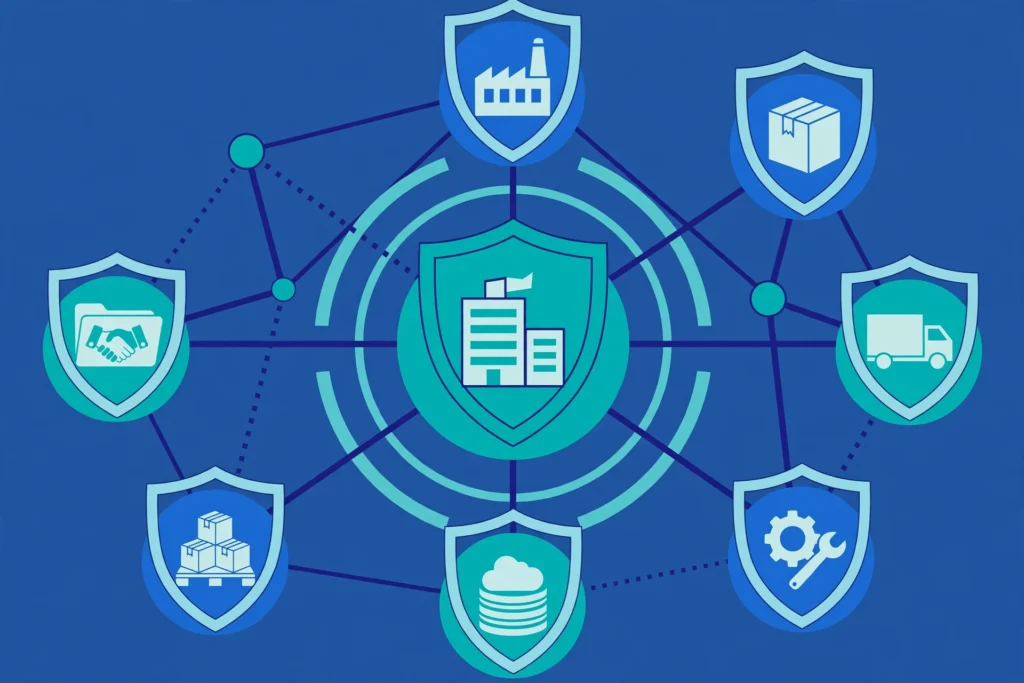
Not every vendor deserves the same scrutiny. A catering company and a cloud provider that hosts your customer data are not the same risk, and treating them the same wastes time on one and leaves the other under-examined.
Tier vendors by what they can touch: access to your data, access to your systems, access to your customers, and the business impact if they fail. High-tier vendors get deep assessments, contractual security requirements, and continuous monitoring. Low-tier vendors get a lighter touch. The point of tiering is not to do less work. It is to spend your effort where the risk is.
2. Replace the annual review with continuous monitoring
Continuous monitoring is now the baseline for mature programs, and the market has noticed. An August 2026 IDC survey found that 37.6 percent of organizations now use continuous, API-based monitoring as their primary third-party risk cadence. The same survey found that confidence in third-party risk posture remains one of the lowest-scoring dimensions of enterprise GRC program maturity, which tells you the gap is real and widely recognized.
Continuous monitoring means live signals, not annual paperwork: security ratings and external attack surface data, breach and threat intelligence feeds, certificate and domain monitoring, and alerts when a vendor’s posture changes. When a critical vendor’s security rating drops or a new vulnerability hits their stack, you should know that week, not at next year’s renewal.
This does not replace questionnaires and SOC 2 reports. It changes their role. Point-in-time evidence becomes a snapshot inside a continuous picture, not the whole picture.
3. Put it in the contract before you need it
The time to negotiate breach notification, audit rights, data return, and termination assistance is before you sign, not after an incident. A vendor contract should answer, in writing: how quickly must they notify you of a breach, what evidence can you demand, what happens to your data when the relationship ends, and what security standards must they maintain throughout the term, not just at onboarding.
Too many organizations discover these gaps during an incident, when their leverage is gone. Contract language is a security control. Treat it like one.
4. Plan for the vendor failing, not just for the vendor being attacked
Resilience is the part of third-party risk management most programs skip. What happens if your payment processor goes down for a day? If your cloud provider has a regional outage? If a key SaaS vendor is acquired and the product is discontinued? The October 2025 AWS incident answered that question for a lot of companies in real time.
A mature program tests recovery: documented playbooks for losing a critical vendor, tested alternatives for single points of failure, and tabletop exercises that include vendor-failure scenarios. Readiness, not control, is what makes vendor exposure manageable when it fails.
Where to Start: A 90-Day Plan
If your third-party risk management program is still running on annual questionnaires, you do not need to rebuild everything at once. You need a credible plan that closes the biggest gaps first.
Days 1 to 30: Know what you have. Build a complete vendor inventory, including the tools teams adopted without IT approval. Assign every vendor a tier based on data access and business impact. Identify your top ten critical vendors and your single points of failure. Most organizations find vendors they had forgotten about in this step alone.
Days 31 to 60: Baseline the critical tier. For your highest-risk vendors, gather current evidence: SOC 2 reports, security certifications, and external security ratings. Review contracts for breach notification, audit rights, and data return clauses. Start continuous monitoring on the critical tier, even if that begins with a simple alert feed.
Days 61 to 90: Operationalize and govern. Establish a vendor risk review cadence, with quarterly board or executive reporting on third-party risk, which Gartner and NIST both frame as a governance obligation. Document your tiering criteria, your monitoring process, and your incident playbook for a vendor breach. Assign a named owner for the program. Then repeat the cycle, extending monitoring to the next tier.
Ninety days will not make your program perfect. It will make it defensible, and it will move you from a position where a vendor breach is a surprise to one where it is a scenario you have prepared for.
The Business Case Writes Itself
Third-party risk management is often sold as a compliance cost. It is better understood as a commercial advantage. Customers increasingly ask for it in due diligence. A strong vendor program shortens sales cycles, because your answers to their security questionnaires are real and current, not aspirational. It protects revenue, because a vendor incident that you detect early and handle well is a story of competence, while one you learn about from the press is a story of negligence. And it protects the business itself, because the organizations that survive supply chain incidents are the ones that saw them coming.
The vendors you choose are extensions of your business. Their security posture is your security posture, their incident is your incident, and their failure is your failure, at least in the eyes of your customers. The question is not whether you can afford to manage that risk. It is whether you can afford to keep pretending an annual questionnaire manages it for you.
How Nabaya Solutions Can Help
Nabaya Solutions has been helping organizations build practical, defensible cybersecurity and compliance programs since 2010. Our third-party risk management work covers the full program: vendor inventory and tiering, risk assessments aligned to NIST CSF 2.0 and NIST SP 800-161, continuous monitoring design, contract security requirements, and board-level reporting that turns vendor risk into a governance conversation.
We also connect vendor risk to the frameworks you already live with. Third-party oversight is a requirement in ISO 27001, SOC 2, CMMC, and HIPAA alike, and a single, well-built program can satisfy all of them at once instead of four separate efforts. That is the difference between compliance as a burden and compliance as an operating advantage.
If your third-party risk management program still runs on annual questionnaires, or if you are not sure what your vendors would do in a breach, that is the conversation to have now, before a vendor makes the decision for you. Contact Nabaya Solutions to start building a third-party risk program that watches your vendors the way your business depends on them.
Protecting What Matters Most.
Pingback: CMMC Phase II Suspended: What Defense Contractors Must Still Do Now
Pingback: CIRCIA Incident Reporting Requirements: A Compliance Playbook for Critical Infrastructure Organizations
Pingback: HIPAA Security Rule Update 2026: What Healthcare Organizations Must Do Before the 240-Day Clock Starts